.svg)


.svg)


An Oregon Guide
In-Home Health Care vs. In-Home Care: What’s the Difference?
When you start looking into care for an aging parent or a recovering loved one, you’ll quickly run into two phrases that sound almost identical: “in-home care” and “in-home health care.” People use them interchangeably in everyday conversation — but in Oregon, they describe two genuinely different services, delivered by different people, licensed under different rules, and paid for in different ways.
Knowing which one you actually need can save you weeks of phone calls, head off billing surprises, and make sure your loved one gets the right kind of help. Here’s a clear breakdown.
Two different services, two different licenses
Oregon doesn’t treat “care at home” as one big category. The state licenses home-based care providers under separate frameworks through the Oregon Health Authority:
- In-Home Care Agencies (IHCAs) provide non-medical personal care and support.
- Home Health Agencies (HHAs) provide skilled medical services under a doctor’s direction, and are often Medicare-certified.
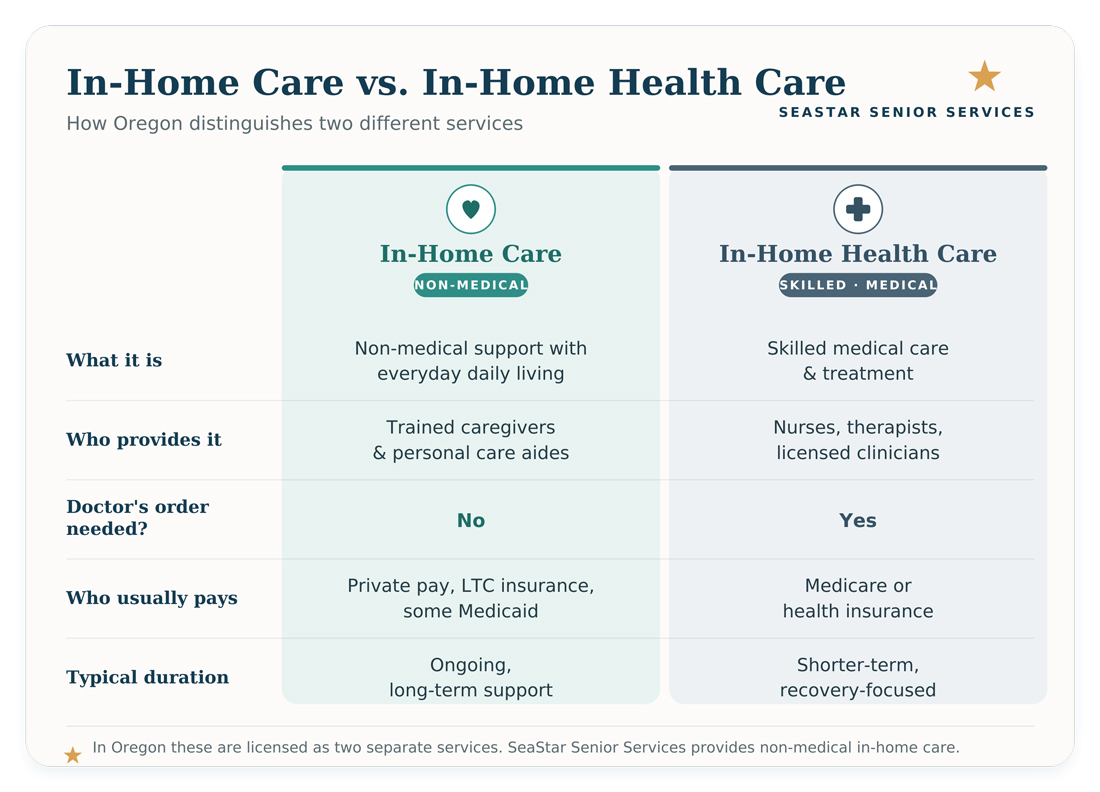
That single distinction — medical vs. non-medical — drives almost everything else: who shows up at the door, what they’re allowed to do, and who pays the bill.
In-home care: help with daily life
In-home care (sometimes called personal care, custodial care, or simply “home care”) is about supporting someone with the everyday tasks that have become difficult. It’s non-medical by definition — Oregon’s rules specifically describe these as services that help a person meet daily needs but do not include curative or rehabilitative treatment.
Typical in-home care includes:
- Help with bathing, dressing, grooming, and toileting (often called “activities of daily living”)
- Meal planning and preparation
- Light housekeeping and laundry
- Medication reminders
- Mobility assistance and fall prevention
- Transportation to appointments, errands, and social outings
- Companionship, supervision, and support for memory-related needs
Who provides it: Trained caregivers and personal care aides — not necessarily licensed medical professionals.
How it’s usually paid for: Most in-home care is private-pay or covered by long-term care insurance. Some Oregonians qualify for Medicaid-funded in-home services. It is generally not billed to Medicare.
When it’s the right fit: When someone is largely stable health-wise but needs a hand with daily living to stay safe and independent at home — support that can continue for months or even years.
In-home health care: skilled medical treatment
In-home health care is clinical. These are medical services delivered in the home by licensed professionals, and in Oregon they’re tied to a physician’s plan of care.
Typical in-home health care includes:
- Skilled nursing (wound care, injections, IV therapy, catheter care)
- Physical, occupational, or speech therapy
- Monitoring and management of chronic or acute conditions
- Medication administration and clinical assessment
- Post-surgical or post-hospital recovery care
Who provides it: Registered nurses, licensed therapists, and other credentialed clinicians.
How it’s usually paid for: When a doctor orders it and the patient meets the criteria, Medicare or private health insurance often covers it.
When it’s the right fit: Usually after a hospital stay, surgery, or new diagnosis — often shorter-term and focused on recovery or stabilizing a medical condition.
.svg)

